

Rodents
Professional Rodent Management & Prevention
A rodent infestation is one of the most challenging and disruptive issues a property owner can face. Highly resilient, adaptable, and persistent, rats and mice are relentless in their search for food, water, and shelter. Thanks to their flexible skeletal structures, mice can squeeze through gaps as small as a pencil head, while rats can enter through openings no larger than a coin.
Attempting to eliminate a rodent population without expert intervention often leads to frustration. DIY methods typically target visible pests while failing to address the hidden nest, entry points, or rapid breeding cycles behind the walls.
Severe Health Hazards & Contamination Risks
Beyond sleep-depriving noises in roof spaces, unpleasant odours, and chewed wiring, rodents pose serious public health risks through the transmission of harmful pathogens.
Leptospirosis
A bacterial infection transmitted through direct or indirect contact with rodent urine, blood, or contaminated water. Symptoms range from severe flu-like illnesses to critical organ dysfunction.
Rat bite fever
Transmitted via rodent bites, scratches, or the consumption of food and water contaminated with rodent droppings and urine.
Salmonellosis
Rodents spread Salmonella bacteria across kitchen countertops, food preparation areas, and storage pantries, leading to severe gastrointestinal illness.
Avian Influenza (H5N1) Vectors:
Worldwide, rodents have been identified as potential carriers of the H5N1 viral strain. Because rodents share habitats with wild birds—often scavenging carcasses or raiding nests—they create a dangerous bridge for cross-species contamination into human living areas.
Common Rodent Species in New Zealand & Their Reproduction Rates
New Zealand is home to four primary invasive rodent species capable of causing severe structural damage and hygiene risks: the House Mouse and three distinct rat species (Ship Rat, Norway Rat, and Kiore).
Once inside a home or commercial building, their population grows exponentially due to remarkable breeding frequency:
House Mouse (Mus musculus):
Litters: 5 to 10 per year (averaging 4 to 8 pups per litter)
Breeding Cycle: Under optimal indoor conditions, females can reproduce every 40 to 50 days.
Ship Rat / Roof Rat (Rattus rattus):
Litters: 3 to 6 per year (averaging 4 to 8 pups per litter)
Behaviour: Agile climbers that prefer roof spaces, attics, and elevated structural voids.
Norway Rat / Sewer Rat (Rattus Norvegicus):
Litters: 4 to 6 per year (averaging 8 to 12 pups per litter)
Behaviour: Larger, burrowing rodents typically found near foundations, subfloors, and drainage networks.
Professional Rodent Control & Exclusion Services
We provide comprehensive rodent management that goes beyond elimination to focus on long-term prevention. Protecting your property from mice and rats requires an integrated approach to treatment and exclusion.
Prevention & Exclusion Measures
A critical component of effective rodent control is sealing potential entry points. Mice and rats require remarkably small openings to gain access:
Structural Vulnerabilities: Rodents can squeeze through tiny gaps or gnaw through surrounding materials to enlarge openings.
Proactive Sealing: Identifying and blocking these entry points is essential to prevent future infestations.
Targeted Treatment & Ongoing Monitoring
Bait Station Deployment: Strategic placement of secure bait stations around your property.
Routine Maintenance: Regular monitoring and bait replenishment to ensure continuous control.
Flexible Duration: Stations remain on-site for as long as necessary to resolve the issue completely.
Service Details & Expectations
Rodent Behavior: Once the bait is ingested, rodents typically leave the structure in search of water.
Carcass Handling: Our standard service does not include dead rodent removal. Should you locate a carcass on your premises, please dispose of it promptly and safely.
Pet Safety & Antidote Availability:
We take domestic animal safety seriously. In the rare event of accidental ingestion by domestic pets, the anticoagulant compounds we use can be effectively reversed using Vitamin K1 under standard veterinary care.
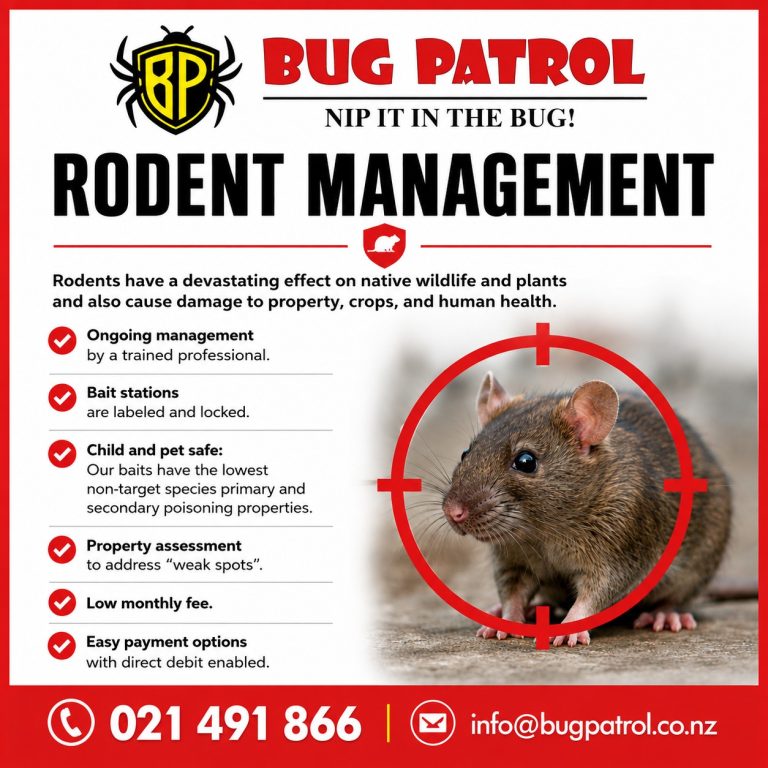
Proactive Defence: Our Annual Rodent Management Plan
Reactive pest control only addresses problems after damage has already occurred. True peace of mind requires a continuous, multi-barrier strategy that stops rodents before they breach your perimeter.
At Bug Patrol, we deliver cost-effective, long-term rodent management tailored for both residential and commercial properties.
Key Features of Our Service:
- Comprehensive Site Assessments: Identifying entry points, structural vulnerabilities, and active nesting sites.
- Strategic Exterior & Interior Control: Utilizing secure, tamper-resistant baiting and trapping (in some instances) stations to intercept rodents around the property.
- Affordable Monthly Plans: Our Annual Rodent Management Plan provides budget-friendly, regular maintenance visits to ensure year-round protection.
- Safeguarding Local Biodiversity & Health: Responsible pest management protects not only your immediate living space but also New Zealand’s unique native ecosystem by curbing predatory rodent populations.